01
Technician calibration
FaultAssist can explain more fully to newer technicians and speak more directly to experienced technicians.
Manufacturing · OEM service · technician support
FaultAssist is the first AISA Assist-domain brand: a diagnostic support system for industrial faults, technician development, OEM support consistency, and knowledge preservation.
The difference on the floor
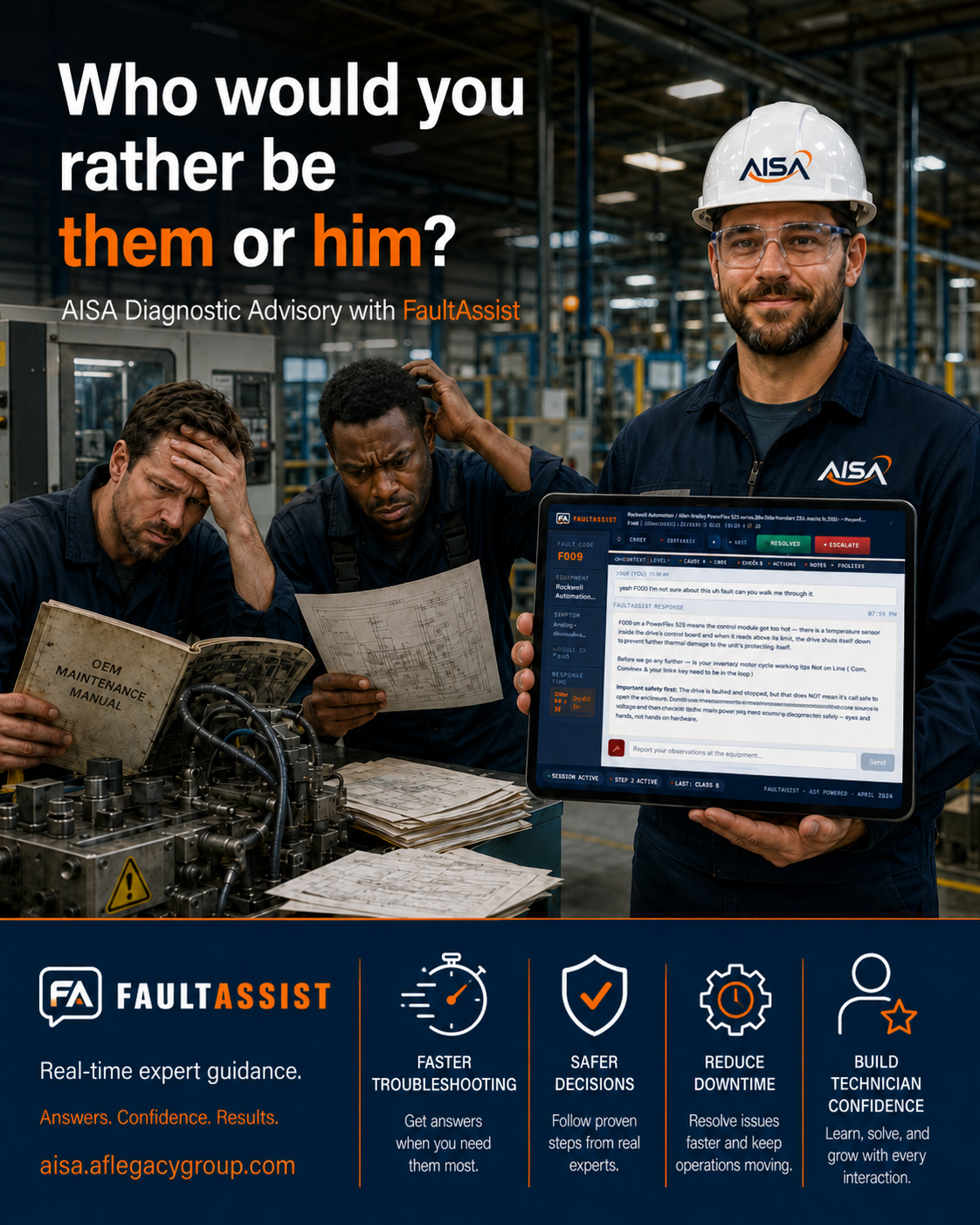
When a fault hits, the manual and the printouts run out fast. FaultAssist™ puts real-time expert guidance in the technician's hands — so the answer comes with confidence, not guesswork.
Watch the demo
Watch how FaultAssist™ walks a technician through diagnosing real industrial faults step by step. The system reasons alongside the operator, surfaces likely causes, and keeps clear safety boundaries while preserving hard-won equipment knowledge for the whole team.
Short demo version. A full demo video is available under a Non-Disclosure Agreement (NDA). Qualified manufacturers, water and wastewater utilities, and OEMs can also request a live API demo session using their own equipment, fault history, or support scenario.
Why it is different
The differentiator is not that it uses AI. The differentiator is the governed method for supporting field judgment in a real industrial setting.
FaultAssist can explain more fully to newer technicians and speak more directly to experienced technicians.
The technician remains accountable. FaultAssist™ supports reasoning; it does not take ownership away from the person at the machine.
FaultAssist can stop or escalate when a step crosses into energized work, unsafe assumptions, or authorization limits.
It should not invent fault codes, causes, or procedures when the domain does not support the answer.
The system can help capture troubleshooting paths and preserve senior knowledge in a usable structure.
Each fault becomes a learning moment, helping technicians build reasoning capability over time.
Where it helps
Support technicians through recurring equipment faults and reduce dependence on tribal knowledge.
Scale equipment expertise across customer support, field service, and internal technical teams.
Turn repeated fault response into a more consistent diagnostic process.
Help newer technicians learn the reasoning behind the fix, not just the steps.
Getting started
You don't have to begin with a full platform deployment. Start with a real diagnostic review of where your troubleshooting is inconsistent today, and see exactly where FaultAssist™ strengthens it before you commit further.
Pinpoint the recurring fault families or equipment classes where support is inconsistent.
Map your documentation, technician workflow, safety boundaries, and escalation points.
Benchmark your current process against the FaultAssist™ support model.
Run a focused pilot on one machine group, OEM line, or high-value fault family.
Pilot structure
Choose a high-value equipment class, recurring issue, or OEM support area.
Build the support logic around real equipment, safety rules, documentation, and technician roles.
Use realistic scenarios to evaluate usability, trust, and operational fit.
Review where FaultAssist™ belongs in service, training, troubleshooting, or escalation workflows.
The bottom line